The Rare Hairless Dog of the Andes
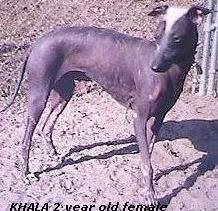
Other Names: Khala (Bolivian Quechua Indian name meaning ‘no clothing’), Hairless Khala Medio, Hairless Khala Grande, Bolivian Khala
The Bolivian Khala Dog, often simply called the Khala, is one of the least understood hairless dogs in the world. Unlike the better-known Xoloitzcuintli or Peruvian Inca Orchid, the Khala has remained obscure outside its home region. English-language information is sparse, and much of what appears online is incomplete, repetitive, or overly simplified.
What careful research suggests is that the Khala is best understood as a rare Bolivian hairless dog landrace with deep ties to the Andean world. It is part of the broader story of Latin American hairless dogs, but it has also persisted as a local type in its own right.
What Is the Bolivian Khala Dog?
The Khala is a rare hairless dog associated with Bolivia and the Andean region. Rather than being a tightly standardized modern breed, it is better described as a regional dog type or landrace that developed within local communities.
That matters because the Khala does not have the same kind of globally accepted breed standard as more established hairless dogs. Descriptions vary, and some sources blur the Khala together with other South American hairless dogs. The most responsible way to describe it is as a native Bolivian hairless dog with traditional forms rather than one universally fixed standard.
Name Meaning
The name Khala is generally associated in Bolivian usage with ideas such as bare, naked, or without clothing. That fits the dog’s appearance and is the most practical interpretation for breed writing.
At the same time, language history in the Andes is complex. Meanings can shift across regions, spellings, and indigenous-language traditions. For that reason, it is safest to say that the name is associated with bareness or nakedness in this dog context, rather than making a more rigid linguistic claim than the evidence supports.
Two Traditional Types of Khala
Spanish-language descriptions of the Khala commonly describe two traditional forms rather than one single standardized body type.
Khala Medio
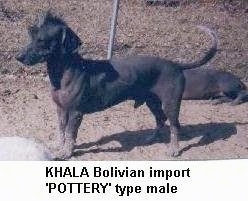
The Khala Medio is generally described as the more compact type. It tends to have a smaller frame, shorter legs, and a lighter overall build. Sometimes called the “Pottery” type of Khala.
Khala Grande
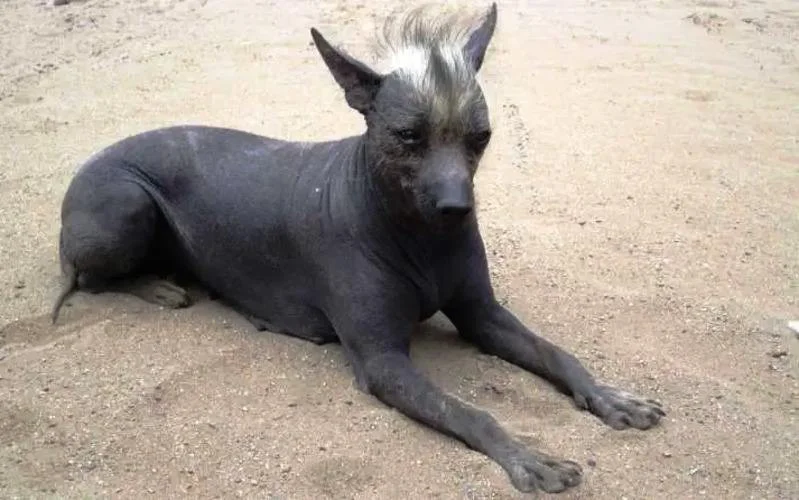
The Khala Grande is the taller and more athletic form. It is typically described as longer-legged, stronger in build, and more physically refined.
These types are useful for understanding how the Khala has traditionally been described, but they should not be mistaken for globally standardized show categories.

Origins: Facts and Traditions
The Khala belongs to the wider group of Latin American hairless dogs that includes the Xoloitzcuintli, the Peruvian Inca Orchid, and the Argentine Pila Dog. It is closely tied to the Andean world and is best understood in that broader regional context.
What appears well supported: the Khala is a Bolivian hairless dog with roots in the Andean region and historical connections to neighboring hairless dog traditions.
What should be treated more cautiously: some sources describe the Khala as a sacred pre-Columbian dog, or present highly specific claims about ritual use and direct ancient lineage. Those claims may reflect genuine tradition, but they are better presented as cultural beliefs and repeated historical traditions rather than hard fact.
That distinction matters. One of the most interesting things about the Khala is not just its possible antiquity, but the fact that it seems to have survived without ever being fully formalized into a modern national breed project.
Why the Khala Is Less Known Than Other Hairless Dogs
One reason the Khala is so little known is that Bolivia did not develop the same level of formal preservation and international promotion that Peru did for the Peruvian Inca Orchid. As a result, the Khala remained more local, more variable, and more lightly documented.
That does not make it less important. In some ways, it makes it more valuable as a surviving regional type.
Relationship to Other Hairless Breeds
The Khala clearly belongs in the same broader family as other hairless dogs of Latin America. It shares the same general hairless phenotype and occupies the same broad historical geography as the Peruvian Inca Orchid and the Argentine Pila Dog.
Still, it would be too simplistic to describe the Khala as merely a version of one of those breeds. The better conclusion is that these dogs likely share regional ancestry, overlapping history, and perhaps past interbreeding, while the Khala also persisted in Bolivia as its own local type.
Appearance
Because the Khala is not strongly standardized, appearance varies from dog to dog. Most descriptions emphasize a hairless or nearly hairless body, with possible sparse hair on the head, tail, or feet.
Skin color may vary widely and can include darker tones, pinkish tones, or spotted patterns. As with many hairless dogs, the skin itself is part of the breed’s visual character.
Writers should be careful not to overstate measurements or structure. Precise height and weight ranges often come from minor registries rather than a universally accepted standard.
Temperament
Descriptions of the Khala commonly present it as a loyal household companion and an alert home dog. It is often described as attached to its people and aware of its surroundings.
That said, the Khala is a rare and lightly documented dog. Without broad modern breed standardization, temperament is best understood as variable. Traditional descriptions are useful, but they should not be treated as guarantees for every individual dog.
Health and Hairless Dog Genetics
Like other hairless breeds, the Khala raises interesting questions about skin, teeth, and genetics. In well-studied hairless breeds such as the Xoloitzcuintli, Peruvian Inca Orchid, and Chinese Crested, hairlessness is associated with genetic changes that can also affect dentition.
However, the published scientific record on the Khala itself is limited. That means it is safer to say that the Khala may share some of the same skin and dental tendencies seen in other classic hairless breeds, rather than claiming that this has already been fully documented in breed-specific research.
As with other hairless dogs, owners should expect to think about:
- sun protection
- cold sensitivity
- skin irritation
- regular skin care
- dental monitoring
For more general grooming and care guidance, see our articles on hairless dog skin care and care and keeping guide for hairless dogs.
Recognition and Rarity
The Khala is not recognized by the largest international kennel systems in the same way as the most established hairless breeds. That lack of standardization has contributed to its obscurity.
Today, the Khala remains one of the least documented native hairless dogs in South America. For that reason alone, it deserves more careful attention than it usually receives.

Why the Bolivian Khala Dog Matters
The Khala matters because it preserves something older and less processed by modern kennel culture. It represents a thread in the wider story of how hairless dogs developed, survived, and became tied to specific human communities.
It also reminds us that not every important dog fits neatly into a modern breed registry. Some survive in fragments, in regional memory, and in living local populations.
The Khala is one of those dogs.
The Bottom Line
The Bolivian Khala Dog is best understood as a rare native hairless dog of Bolivia with deep Andean roots. It is part of the broader family of Latin American hairless dogs, but it should not simply be collapsed into better-known breeds.
Some things about the Khala can be stated with confidence: it is Bolivian, hairless, rare, and historically tied to the Andes. Other claims, especially those involving ritual roles or highly specific ancient history, are better treated as tradition rather than proven fact.
That combination of reality and legend is part of what makes the Khala so compelling.
If you are interested in the broader story behind dogs like the Khala, also see our guides to the Xoloitzcuintli, the Peruvian Inca Orchid, the Argentine Pila Dog, and our overview of hairless dog breeds.